
🌐 Grid Computing Explained: How the World’s Biggest Problems Are Solved by Millions of Computers Working Together 🚀

Imagine borrowing unused computing power from thousands—or even millions—of computers around the world to solve problems so massive that a single supercomputer would struggle.
That’s not science fiction.
That’s Grid Computing.
From discovering the Higgs Boson at CERN 🧪 to NASA’s climate simulations 🌍, from drug discovery to financial risk modeling, grid computing quietly powers some of humanity’s most important breakthroughs.
In this deep-dive guide, we’ll explore:
What Grid Computing really is (in plain English)
How it actually works behind the scenes
Where it’s used in the real world
How CERN and NASA rely on it at scale
Industry-level adoption stories (what worked, what didn’t)
Popular tools and middleware used to build grid systems
Why grid computing still matters in the age of cloud & AI
Let’s begin 👇
🧠 What Is Grid Computing?
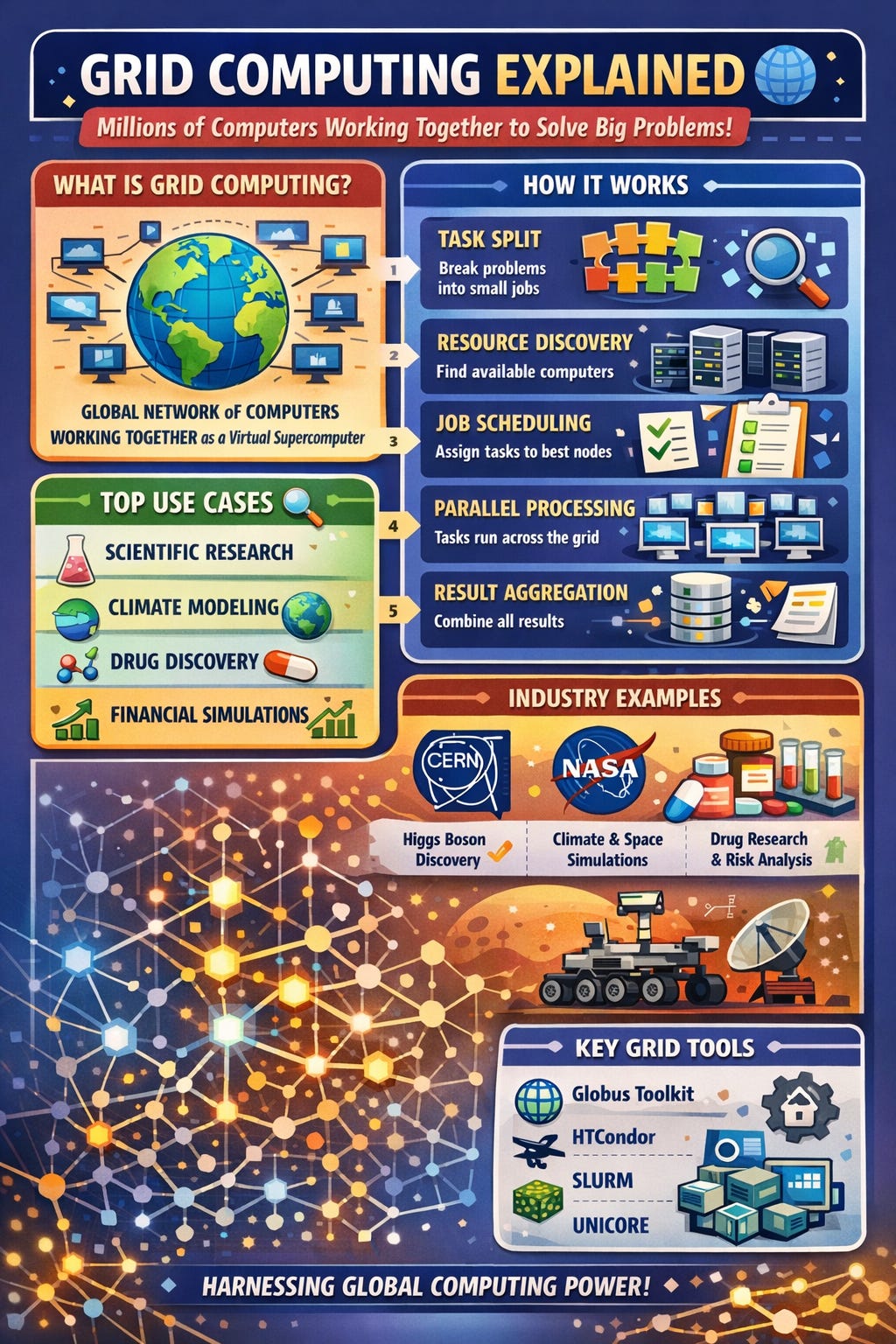
Grid Computing is a distributed computing model where multiple independent computers—often geographically dispersed—work together as a single virtual supercomputer to solve large, complex tasks.
Each computer (or node) in the grid contributes:
Processing power (CPU/GPU)
Memory
Storage
Network bandwidth
These resources are coordinated by specialized software so users experience them as one unified system.
A Simple Analogy 🧩
Think of grid computing like a neighborhood potluck dinner:
Everyone brings what they can (food/resources)
A coordinator organizes the meal
No single person cooks everything
Together, you create something much bigger than any individual could alone
That’s grid computing—collaboration at massive scale.
🏗️ Key Characteristics of Grid Computing
Grid computing has a few defining traits:
Decentralized – No single machine controls everything
Heterogeneous – Different hardware, operating systems, locations
Scalable – Add more nodes without redesigning the system
Fault-tolerant – If one node fails, others take over
Resource-sharing oriented – Often spans organizations or institutions
This makes it ideal for scientific, engineering, and data-intensive workloads.
⚙️ How Grid Computing Works (Step-by-Step)
Let’s break it down in a way that actually makes sense 😊
1️⃣ Task Decomposition
A large problem (say, analyzing petabytes of particle collision data) is split into thousands or millions of smaller tasks.
Each task:
Is independent or loosely coupled
Can be processed in parallel
2️⃣ Resource Discovery
Grid middleware identifies:
Available computers
Their current load
CPU, memory, storage capacity
Network conditions
3️⃣ Job Scheduling
A scheduler assigns tasks to nodes based on:
Resource availability
Priority
Data locality (to reduce network transfer)
Policies and quotas
4️⃣ Execution Across the Grid
Each node:
Executes its assigned task
Reports progress and results
Handles retries if failures occur
5️⃣ Result Aggregation
Outputs from all nodes are:
Collected
Verified
Combined into a final result
To the user, it feels like one powerful machine did all the work ✨
🧬 Grid Computing vs Cloud Computing (Quick Clarity)
This confusion is common, so let’s clear it up.
Grid computing:
Emerged before modern cloud
Focuses on federated, shared resources
Often spans multiple institutions
Prioritizes scientific workloads
Cloud computing:
Centralized data centers
Owned by a single provider
Commercial, pay-as-you-go model
Easier provisioning
👉 Many modern systems actually combine grid principles with cloud infrastructure.
🔍 Real-World Use Cases of Grid Computing
Grid computing shines where problems are too big, too complex, or too data-heavy.
🧪 Scientific Research
Particle physics simulations
Genomics and protein folding
Climate and weather modeling
Astrophysics simulations
🧬 Healthcare & Drug Discovery
Virtual drug screening
Genome analysis
Pandemic modeling
💰 Finance & Risk Analysis
Monte Carlo simulations
Portfolio risk modeling
Fraud detection
🌍 Climate & Earth Sciences
Climate change projections
Earthquake simulations
Ocean and atmospheric modeling
🧠 AI & Machine Learning (Hybrid Grids)
Large-scale training jobs
Hyperparameter tuning
Distributed inference
🔬 CERN: Grid Computing at Planetary Scale
No discussion of grid computing is complete without CERN.
The Problem CERN Faced
The Large Hadron Collider (LHC) generates:
~30 petabytes of data per year
Billions of particle collision events
Thousands of scientists worldwide needing access
No single supercomputer—or even country—could handle this alone.
The Solution: Worldwide LHC Computing Grid (WLCG)
CERN built the largest grid computing infrastructure on Earth.
🌐 How WLCG Works
170+ data centers
40+ countries
Over 1 million CPU cores
Exabytes of distributed storage
The system uses a tiered architecture:
Tier-0 (CERN) Initial data capture and processing
Tier-1 (National Centers) Large-scale storage and reprocessing
Tier-2 (Universities & Labs) Simulation and analysis
Tier-3 (Local Clusters) Individual research groups
🏆 Results That Changed Physics
Discovery of the Higgs Boson (2012)
Precision measurements of fundamental particles
Continuous global collaboration
🚀 NASA: Grid Computing Beyond Earth
NASA deals with problems that are:
Computationally extreme
Mission-critical
Time-sensitive
Where NASA Uses Grid Computing
🌍 Climate Modeling
NASA runs complex Earth system models combining:
Atmosphere
Oceans
Ice sheets
Land systems
Grid computing allows simulations that span decades or centuries of virtual time.
🛰️ Space Missions & Aerodynamics
Computational Fluid Dynamics (CFD)
Spacecraft design simulations
Entry, descent, and landing modeling (Mars missions)
🧠 Earth Observation & Satellite Data
NASA satellites generate massive data streams daily.
Grid infrastructures enable:
Distributed processing
Fast analytics
Global access for researchers
Tools NASA Has Used
Condor / HTCondor
Globus Toolkit
Custom grid schedulers
Hybrid grid-cloud models
Grid computing helps NASA reduce cost, increase reliability, and scale globally 🌌
🏭 Industry Adoption: Real Examples That Worked
Grid computing isn’t just for scientists in labs. Many industries quietly rely on it.
💊 Pharmaceutical Industry: Faster Drug Discovery
Companies like:
Pfizer
Novartis
GlaxoSmithKline
Use grid computing for:
Virtual screening of millions of molecules
Protein-ligand docking simulations
Reducing years of lab work to months
Result:
Lower R&D costs
Faster time-to-market
Better targeting of promising compounds
💰 Financial Services: Risk at Scale
Investment banks and hedge funds use grid systems to:
Run millions of Monte Carlo simulations
Model market volatility
Stress-test portfolios
Grid computing allows:
Overnight risk calculations
Real-time decision-making
Compliance with regulatory demands
🎬 Media & Entertainment
Studios use grid-like render farms for:
CGI rendering
Visual effects
Animation pipelines
Each frame can be processed independently—perfect for grid
🔐 How Grid Computing implements Security & Identity for secure computing
Grid systems rely heavily on:
Public Key Infrastructure (PKI)
Digital certificates
Virtual Organization Membership Services (VOMS)
Security is critical when resources span organizations 🔐
📈 Why Grid Computing Still Matters in 2026
You might wonder:
“With cloud computing everywhere, is grid computing still relevant?”
Short answer: Yes—more than ever.
Reasons Grid Computing Is Still Essential
Massive scientific collaborations can’t rely on one vendor
Data sovereignty matters across countries
Cost-sharing models suit academia and research
Hybrid cloud-grid systems are becoming standard
AI workloads increasingly resemble grid-style parallelism
In fact, many modern distributed systems borrow directly from grid computing principles.
🔮 The Future of Grid Computing
Grid computing is evolving, not disappearing.
What’s Coming Next 🚀
Integration with AI & ML pipelines
Containerized grid workloads (Docker + Kubernetes hybrids)
Quantum-grid experimentation
More citizen-science grids (like SETI@home-style projects)
Tighter cloud interoperability
The idea remains the same:
Harness collective computing power to solve problems bigger than any one machine—or organization—can handle.
✨ Final Thoughts
Grid computing is one of the quiet giants of modern technology.
It doesn’t get flashy headlines like AI or blockchain, but without it:
We wouldn’t understand the universe at a fundamental level
Climate science would lag decades behind
Drug discovery would be slower and more expensive
Global scientific collaboration would be far more limited
From CERN’s particle collisions to NASA’s space missions, grid computing proves that collaboration—at scale—changes everything 🌍
If you found this guide helpful, consider sharing it with:
Engineers
Researchers
Students
Tech leaders curious about distributed systems
Because the future isn’t just faster computers—it’s computers working together 🤝