
Distributed Artificial Intelligence: What It Is, How It Works, and the Game-Changing Future in 2026 🚀

Unlock distributed artificial intelligence: definition, architecture, real-world use cases, how it works, and 2026 predictions. Scale AI like never before!
The Day AI Became a Hive Mind 🌐
Imagine this.
A massive earthquake strikes a coastal city. Within minutes, autonomous drones take flight. They don’t wait for instructions from a single supercomputer. They don’t depend on one fragile server.
Instead, they coordinate locally.
They share insights instantly.
They adapt in real time.
No central brain.
No single point of failure.
Just a swarm of intelligent systems collaborating like ants rebuilding a colony.
That’s the power of distributed artificial intelligence.
Or think about how Tesla vehicles learn from fleet-wide driving data. Or how Google trains AI models across millions of Android devices using federated learning — without collecting private data centrally.
The future of AI isn’t one giant data center.
It’s everywhere.
It’s collaborative.
It’s decentralized.
So what is distributed AI?
How distributed AI works?
And why is the future of distributed AI one of the most transformative shifts in modern computing?
Let’s dive in.
What Is Distributed Artificial Intelligence? 🤖
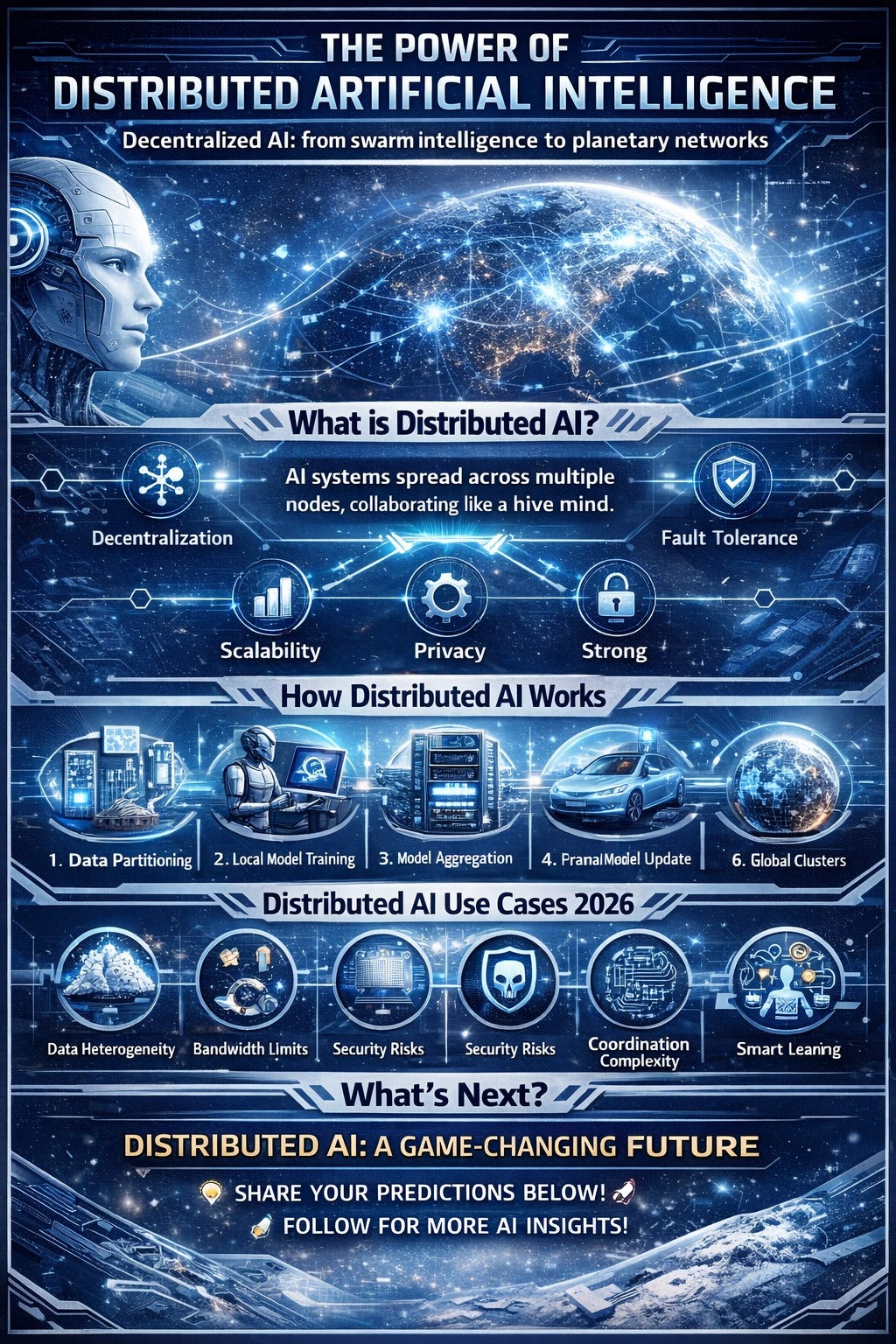
If you’ve searched “what is distributed AI”, here’s the clear definition:
Distributed artificial intelligence (DAI) is a paradigm in which AI systems operate across multiple decentralized nodes, collaborating to solve problems, train models, and make decisions collectively.
Instead of sending all data to a central server, distributed AI architecture spreads computation across many agents or nodes.
These nodes might be:
Edge devices
Smartphones
Autonomous vehicles
IoT sensors
Cloud clusters
The roots of distributed artificial intelligence go back to 1980s research in multi-agent systems at AAAI workshops. The central idea was revolutionary:
Intelligence doesn’t have to live in one place.
It can emerge from collaboration.
In 2016, Google Research introduced federated learning (McMahan et al.), a breakthrough that allowed AI training across devices while keeping raw data local. That paper marked a turning point in distributed machine learning.
Core Principles of Distributed AI
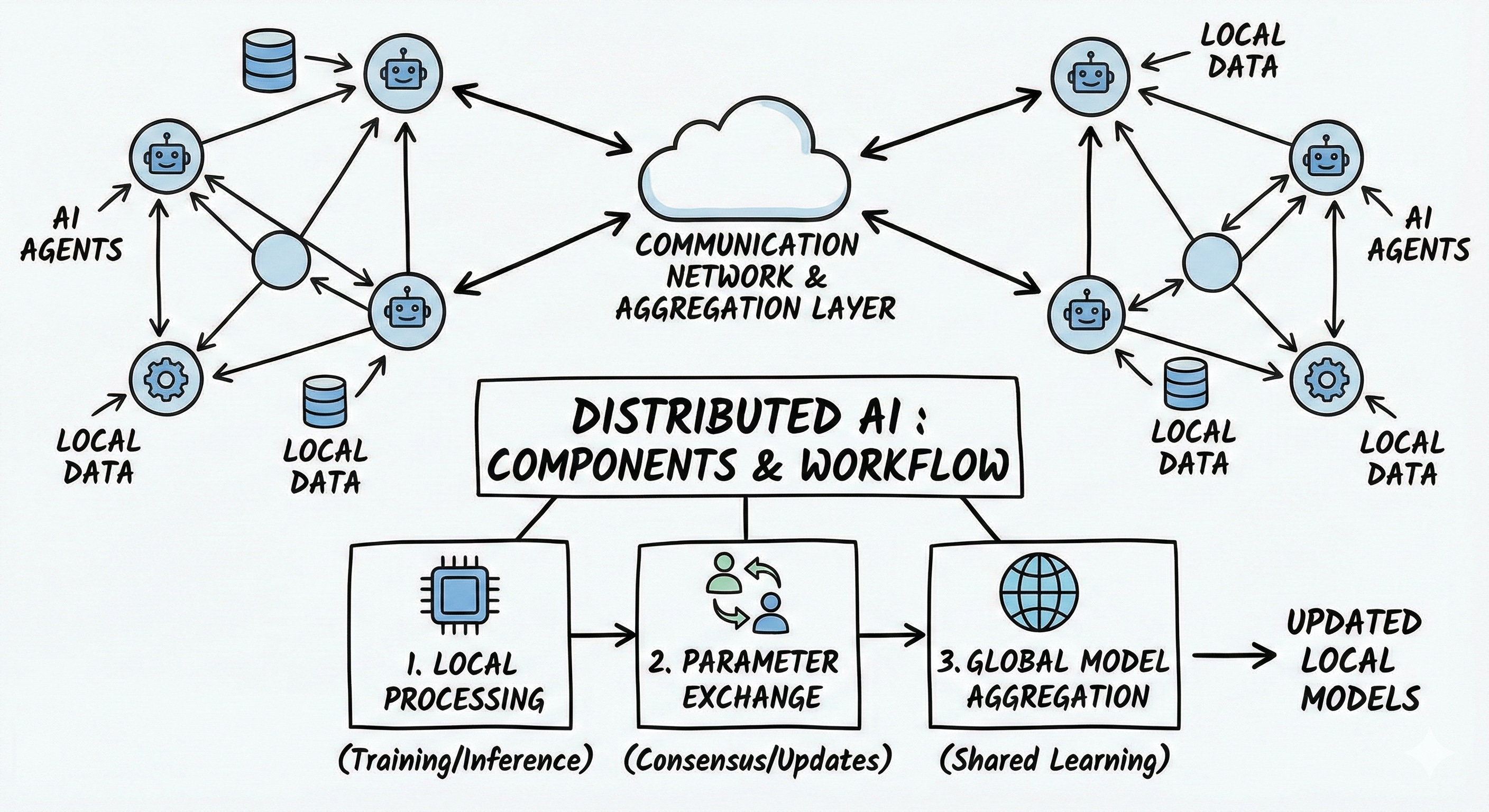
Here are five foundational pillars of distributed artificial intelligence:
Decentralization – No single controlling entity
Parallelism – Tasks run simultaneously across nodes
Fault Tolerance – The system survives node failures
Scalability – Easily expands to millions of devices
Collaborative Intelligence – Agents share learning
This is AI behaving more like a biological ecosystem than a rigid machine.
Distributed AI vs Traditional AI
Distributed Artificial Intelligence
Data stays local or regionally distributed
Horizontal scalability
Stronger privacy controls
Reduced latency via edge AI
Higher resilience
Centralized AI
Data collected into one server
Vertical scaling limitations
Greater privacy risks
Higher latency
Single point of failure
The difference is architectural — and transformative.
Distributed AI Architecture and Components 🏗️
Understanding distributed AI components is key to mastering how distributed AI works.
1️⃣ Intelligent Agents (Nodes)
Each node can:
Process local data
Train machine learning models
Share model updates
Make autonomous decisions
This design is inspired by swarm intelligence — where simple agents collectively produce intelligent global behavior.
2️⃣ Communication Protocols
Distributed AI systems rely on:
Gossip protocols
Consensus algorithms
Peer-to-peer messaging
Blockchain-inspired verification
These allow decentralized AI systems to synchronize knowledge.
3️⃣ Coordination Mechanisms
Multi-agent systems need structure.
Coordination methods include:
Auction-based task allocation
Game-theoretic negotiation
Hierarchical orchestration
Without coordination, distributed AI collapses into chaos.
4️⃣ Data Sharding & Aggregation
In federated learning:
Devices train locally
Only model updates are shared
Raw data never leaves the device
This approach dramatically improves privacy while enabling distributed machine learning at scale.
5️⃣ Orchestration Layers
Modern distributed AI architecture depends on tools like:
Kubernetes
Apache Spark
Ray
These platforms manage large-scale AI workloads across distributed infrastructure.
7 Core Distributed AI Components
Machine learning models
Local data shards
Aggregation servers
Secure communication APIs
Edge compute hardware
Monitoring systems
Security layers
This stack enables scalable distributed artificial intelligence.
How Distributed AI Works (Step-by-Step) ⚙️
Here’s a simplified breakdown of how distributed AI works:
1️⃣ Data Partitioning
Data is divided across devices or nodes.
2️⃣ Local Model Training
Each node trains a model using its own data.
3️⃣ Model Aggregation
Using algorithms like Federated Averaging (FedAvg), updates are combined into a global model.
4️⃣ Global Model Update
The aggregated model improves collective intelligence.
5️⃣ Edge Inference
Predictions are made locally for fast response times.
Key Algorithms Behind Distributed AI
Federated Averaging (FedAvg)
Distributed Gradient Descent
Gossip Learning
Split Learning
These algorithms make distributed machine learning efficient and scalable.
Pros and Cons of Distributed AI
Advantages
Massive scalability
Improved privacy
Reduced latency
Fault tolerance
Edge AI enablement
Challenges
Communication overhead
Model inconsistency
Security risks (e.g., poisoning attacks)
Complex orchestration
Distributed AI is powerful — but not trivial.
Distributed AI Use Cases 2026 🌍
Let’s explore real distributed AI examples in real life.
1️⃣ Smart Cities & Edge AI
Traffic systems use edge AI to optimize flow in real time.
Cameras process video locally instead of sending footage to central servers.
This is DAI in edge computing and IoT transforming urban infrastructure.
2️⃣ Healthcare & Federated Learning
Hospitals collaboratively train diagnostic AI without sharing patient records.
This enables global medical insights while preserving privacy.
Federated learning is becoming foundational to distributed AI use cases 2026 in healthcare.
3️⃣ Autonomous Vehicles
Self-driving fleets share driving insights across vehicles.
Each car contributes to — and benefits from — collective intelligence.
4️⃣ Finance & Fraud Detection
Banks analyze fraud patterns across distributed systems.
Instead of centralizing sensitive data, they use privacy-preserving distributed AI architecture.
5️⃣ Gaming & Entertainment
Massively multiplayer games use distributed AI to power adaptive NPC behavior.
Real-time decisions happen at the edge.
Did You Know? 🤯
Federated learning operates across billions of Android devices.
Distributed AI reduces latency significantly in edge deployments.
Swarm robotics improves task efficiency in coordinated environments.
Distributed AI is foundational to 6G and next-gen IoT research.
The scale is staggering.
Challenges and Solutions ⚠️
Key Challenges
Data heterogeneity
Limited bandwidth
Security vulnerabilities
Synchronization delays
Emerging Solutions
Homomorphic encryption
Secure aggregation
Blockchain-based validation
Efficient communication protocols
The field is evolving rapidly.
The Future of Distributed AI 🌅
The future of distributed AI is not speculative hype. It’s grounded in active research and deployment trends.
Here’s what 2026 and beyond may bring:
1️⃣ Web3 + Decentralized AI
AI models running across blockchain networks for trustless collaboration.
2️⃣ Quantum-Enhanced Optimization
Quantum accelerators improving distributed optimization algorithms.
3️⃣ Planet-Scale Health Networks
Global federated models detecting pandemics early.
4️⃣ Smart Energy Grids
Distributed AI managing electricity demand and preventing blackouts.
5️⃣ Collective Superintelligence 🌐
From isolated AI systems to globally connected intelligence networks.
As AI pioneer Andrew Ng has emphasized in discussions on federated learning, decentralization is critical to scaling AI responsibly.
The latest distributed AI technology is not just scaling AI.
It’s redefining how intelligence itself is structured.
Distributed AI FAQs ❓
Is distributed AI the same as cloud AI?
No. Cloud AI centralizes processing. Distributed artificial intelligence pushes intelligence across many nodes.
Is federated learning a type of distributed AI?
Yes. It’s one of the most practical implementations today.
Does distributed AI improve privacy?
Often yes, especially in federated and decentralized AI systems.
Is distributed AI more scalable?
Yes. It scales horizontally across devices.
Will distributed AI replace centralized AI?
More likely, both will coexist in hybrid architectures.
Final Thoughts 💭
Distributed artificial intelligence is not a buzzword.
It’s infrastructure.
It’s the foundation for scalable, privacy-preserving, fault-tolerant AI systems.
The future of distributed AI will power smart cities, autonomous systems, global healthcare networks, and decentralized digital economies.
Imagine AI that doesn’t crash under billions of devices.
Imagine intelligence that grows stronger the more it spreads.
That’s the promise of distributed artificial intelligence.